For most actors, preparing for a role might involve studying scripts or researching a character’s history. For the voice of Princess Zelda, the preparation went a little further into the lore of Hyrule itself.
Patricia Summersett, the actress who voices Zelda in several modern entries in the series including The Legend of Zelda: Breath of the Wild and Tears of the Kingdom, recently revealed that she taught herself to read and write the Hylian script used in Twilight Princess.
According to Summersett, the journey began while she was preparing for her role as Zelda during the development of Breath of the Wild. While looking through the series companion book Hyrule Historia, she came across the various fictional languages used across the franchise. One in particular caught her attention.
She explained that the version of Hylian seen in Twilight Princess stood out to her because of how elegant it looked. The script resembles a stylized alphabet used throughout the game world, appearing on signs, architecture, and written documents across Hyrule.
Summersett decided she wanted to learn it.
Learning the Language of Hyrule
Rather than studying it formally, Summersett began practicing casually. She said she would spend time learning the characters while sitting with a cup of coffee, gradually memorizing the alphabet until she could comfortably write with it.
Over time, the practice paid off. Summersett says she can now write in the script fluently and still uses it regularly.
Her dedication has also become a fun surprise for fans. When attending conventions, she sometimes writes notes or messages in Twilight Princess Hylian for fans who recognize the symbols. It is a small detail, but one that shows just how deeply she appreciates the world of The Legend of Zelda.
A Unique Bond With the Character
Summersett holds a unique place in the history of the series. When Breath of the Wild launched in 2017, she became the first official English voice for Princess Zelda in a mainline game.
That milestone came with plenty of expectations from longtime fans. Her approach to the role has always reflected a strong respect for the franchise’s lore and legacy.
Learning an in-universe writing system might not be required preparation for a voice acting role. Still, for a series as beloved as The Legend of Zelda, it feels fitting.
And if you ever meet Summersett at a convention, you might walk away with a message written in the language of Hyrule itself.
The Animal Crossing: New Horizons 3.0 update brought a wave of exciting crossover content to the game. One of the most talked about features is the addition of The Legend of Zelda themed items. These furniture pieces and clothing options allow players to bring Hyrule vibes to their islands and homes. If you are a fan of both franchises, this content opens up nearly endless creative possibilities for decoration and cosplay within your island world.
How to Unlock Zelda Items
To access the full set of Zelda items, players need to use any amiibo figure from The Legend of Zelda series at the Nook Stop terminal in Resident Services or at the ABD terminal once unlocked. Scanning even one compatible Zelda amiibo unlocks the entire list of 28 items in the Nook Shopping catalog under the Special Goods section in the Promotion tab. Note that you can only order up to five items per day, so collecting everything will take at least six days.
Zelda Furniture and Decor
Here is the current list of furniture and sturdy decorative items inspired by the Zelda games:
Decayed Guardian – 3,000 Bells
Fairy Bottle – 1,000 Bells
Goddess Statue – 2,500 Bells
Heart – 350 Bells
Heart Container – 2,000 Bells
Master Sword – 5,000 Bells
Rupee – 350 Bells
Silent Princess – 700 Bells
Triforce – 3,333 Bells
Zonai Authentication Crest – 3,000 Bells
Tri Rod – 13,330 Bells
Ocarina of Time – 2,500 Bells
These items represent iconic elements from the Zelda franchise including weapons, symbols, and collectibles that fans will instantly recognize. You can use these pieces to build themed spaces, turn interiors into shrines, or create outdoor exhibition areas around your island.
Zelda Themed Clothing and Wearables
In addition to furniture, the 3.0 update also includes wearable items that let you outfit your character in classic Zelda styles:
Tri Headband – 1,500 Bells
Ancient Princess Wig – 2,000 Bells
Champion Wig – 2,000 Bells
Link Hat – 2,000 Bells
Majora’s Mask – 2,500 Bells
Champion Outfit – 2,300 Bells
Link Outfit – 2,300 Bells
Tulin Outfit – 1,200 Bells
Hylian Trousers – 1,800 Bells
Ancient Princess Costume – 3,000 Bells
Mineru Costume – 1,200 Bells
Ancient Princess Sandals – 1,600 Bells
Hylian Boots – 1,600 Bells
Hero’s Sword and Shield (Bag) – 5,000 Bells
These clothing options let you dress as Link or other iconic characters and personalities from The Legend of Zelda. Fans of Tears of the Kingdom will especially enjoy outfits inspired by Champion characters.
Design Tips for Zelda Fans
Once you have unlocked all Zelda items, you can use them to create themed areas around your island:
Build a Hyrule shrine room filled with statues, Triforce pieces, and Heart Containers.
Create an outdoor Master Sword exhibit in your town plaza.
Set up a Silent Princess garden to mimic the sacred groves from Breath of the Wild.
Use wearables to dress villagers for themed photo shoots or seasonal events.
Because it can take several days to collect everything due to the daily purchase limit, plan your order queue around the items you most want first.
Conclusion
The Zelda crossover content in Animal Crossing: New Horizons brings some of the most beloved elements of the Zelda franchise into your island. From furniture based on legendary weapons to outfits that let you cosplay as Link or other characters, this collection gives fans a rich palette of items to express their love for the series. Whether you want to decorate a room, plan a themed island area, or just wear your favorite outfit while fishing, these additions make the ACNH experience feel even more connected to the broader Nintendo universe.
Fan Brings Classic Hyrule to Life in Animal Crossing: New Horizons
Animal Crossing: New Horizons players continue to impress with the creative ways they use the game’s island customization tools. One standout project is a full island recreation of the original The Legend of Zelda world from the NES era. The creator behind this remarkable design goes by the name NintenFan, and their work offers a nostalgic trip for Zelda fans everywhere.
Using the terraforming tools and furniture options available in Animal Crossing: New Horizons, NintenFan built an island that closely follows the iconic map layout from the original The Legend of Zelda. Although the scale has been adjusted to fit Animal Crossing’s island format, the overall structure stays true to the game’s classic look.
What Makes This Hyrule Recreation Special
Fans of The Legend of Zelda will find plenty to recognize in this island:
The entrance to the first cave, where Link traditionally finds his wooden sword, has been recreated with clever use of props and design.
Multiple dungeon entrances are placed around the island, mirroring their positions on the original game’s overworld map.
Players even used critters like crabs to represent traditional Zelda enemies such as Tektites, adding both charm and nostalgic detail.
This project shows how Animal Crossing’s open design systems can be used for ambitious tributes to other video game worlds. The creator’s use of everyday items and landscape features to mimic Zelda locations highlights the imagination of crossover fans in both communities.
Nostalgia Meets Gameplay
What makes this island recreation stand out is not just a desire to replicate classic Zelda visuals, but also a love of the original game’s world layout. For many players who grew up exploring Hyrule with blocky graphics and simple maps, seeing that world reinterpreted in Animal Crossing brings back memories in a fresh way. It also emphasizes how versatile Animal Crossing: New Horizons has become as a platform for player creativity.
With island customization expanding through updates and community creations growing richer over time, projects like this Hyrule tribute will likely inspire even more imaginative worlds. Whether players are paying homage to classic Nintendo titles or blending genres in unexpected ways, Animal Crossing: New Horizons continues to serve as a blank canvas for fans of all kinds.
If you are a Zelda fan and want to explore this incredible island, keep an eye out for community tours and videos showcasing the full layout. Seeing how Hyrule can live within Animal Crossing offers a unique perspective on both games.
Eiji Aonuma Hints at How Hyrule Warriors Could Influence the Next Zelda Game
Nintendo’s long-running Legend of Zelda series may be taking creative cues from one of its recent spin-offs for the next mainline adventure. Eiji Aonuma, the producer who has guided the franchise for years, dropped some intriguing remarks in a new interview that point to inspiration drawn from Hyrule Warriors: Age of Imprisonment and how that experience could shape what comes after Tears of the Kingdom.
In the discussion with Japanese publication 4Gamer, Aonuma reflected on the collaborative process behind the Koei Tecmo-developed Age of Imprisonment. He chuckled about how Nintendo had hoped to be the first to launch a Zelda title on the Nintendo Switch 2, but instead the spin-off claimed that milestone. Working closely with Koei Tecmo’s team, however, was clearly valuable for Nintendo’s own developers. Aonuma said the creative exchange “may be reflected in the Zelda we create” in the future and encouraged fans to imagine what that might look like while playing Age of Imprisonment.
Eiji Aonuma & Hidemaro Fujibayashi
Hyrule Warriors: Age of Imprisonment arrived on Nintendo Switch 2 in late 2025, offering a high-octane hack-and-slash retelling of the Imprisoning War period depicted in Tears of the Kingdom. Like previous Warriors titles, it blends Zelda lore and characters with intense crowd-combat action inspired by Koei Tecmo’s Dynasty Warriors games.
Aonuma’s comments did not go as far as to confirm specifics about the next mainline Zelda experience. He did not outline gameplay systems or narrative direction, and he stopped short of saying any particular Warriors mechanics would be adopted wholesale. What comes through clearly is that Nintendo is thinking broadly about the series’ future and is open to absorbing ideas from different creative partners.
Fans have reacted with a mix of excitement and speculation. Some see the possibility that future Zelda entries might incorporate more dynamic combat or storytelling approaches influenced by Age of Imprisonment, while others hope the core adventure and world exploration that define the series remain intact. Regardless, Aonuma’s remarks underline that Nintendo’s team is actively exploring fresh directions as the franchise approaches its 40th anniversary era.
For now, concrete details on the next mainline Zelda game remain scarce, but Aonuma’s hints suggest that Nintendo’s creative horizon is expanding with every collaboration. Fans can continue to enjoy Age of Imprisonment and look for the subtle threads of inspiration that might point toward what’s coming next for Link and Hyrule.
Monolith Soft Reflects on Its Growing Role in The Legend of Zelda Series
Monolith Soft recently offered fans a rare look behind the scenes at its long-running partnership with Nintendo on The Legend of Zelda series. In a new interview celebrating more than a decade of collaboration, key figures from both companies reflected on how the relationship has evolved and what it might mean for the future of the franchise.
The Japanese studio best known for the Xenoblade Chronicles series wasn’t always a household name for Zelda fans. Monolith Soft first worked with Nintendo on Skyward Sword back in 2011, contributing important development support early in the Wii era. From those first steps the partnership grew steadily deeper, with the team taking on more creative involvement as Nintendo entrusted it with larger chunks of development responsibility.
By the time Breath of the Wild began to take shape, Monolith Soft’s role had expanded significantly. Staff from Nintendo and Monolith would meet regularly to exchange ideas during Breath’s development and that closer collaboration only strengthened with Tears of the Kingdom. According to the interview subjects, this shift from support work toward a more co-creative process was one of the most rewarding aspects of their shared history.
What makes this interview especially intriguing is how the topic turns toward the future. Daiki Iwamoto, Nintendo’s general manager for the Zelda franchise, spoke about hoping that Monolith Soft could play a “central role as a strong partner in creating the Zelda series from scratch,” rather than simply assisting on parts of production. That kind of language suggests Nintendo sees real value in Monolith’s contributions and may be open to even greater involvement down the road.
Monolith Soft’s own director, Yasuhiro Fujita, also discussed how the studio’s involvement has changed over time. He noted that in the early days the work was more about executing on Nintendo’s designs, but that in recent projects they’ve become a more active part of idea-making and problem-solving alongside Nintendo’s teams.
There’s no official word yet on what this all means in terms of future Zelda titles. A new mainline game hasn’t been formally announced, and it would be premature to assume Monolith Soft will lead development on the next blockbuster entry. Still, the interview makes it clear that the relationship between the two companies is stronger than ever and that the possibility of seeing Monolith take on an even more prominent role in Zelda’s future excites fans and developers alike.
What that future looks like remains to be seen, but for fans who have watched Monolith Soft grow from a support studio into a creative force alongside Nintendo, this interview offers a fascinating glimpse into how one of gaming’s most beloved franchises continues to evolve.
The Legend Grows: Announcing Our New Fan Content Systems
We are incredibly excited to unveil a massive update to Zelda Central that completely transforms how we share and celebrate our creativity. Today marks the launch of our comprehensive Fan Content system. This is a production-ready solution designed to build a vibrant community of Zelda fans right here on the site. We have built a complete framework that allows you to submit, manage, and showcase your own creations through a modern and professional dashboard.
A New Home for Fan Games
The centerpiece of this update is our robust Fan Games System. This new section serves as a comprehensive database for Zelda fan games, ROM hacks, randomizers, and engine quests. Developers can now categorize their projects by base game or engine while managing screenshots, download links, and source code.
We have also included support for various platforms so users can easily find games for Windows, Mac, Linux, or mobile devices. Whether you are working on a massive ROM hack or a unique mod, you now have a dedicated space to display your hard work with proper credits and screenshot galleries.
Comics, Fiction, and Art
We are also thrilled to introduce the Fan Comics System. This platform offers a dedicated creation and reading experience for multi-page comics. Creators can upload files using a tabbed interface, drag and drop pages to reorder them, and even set the reading direction for manga-style layouts.
Readers will enjoy a professional full-screen interface with keyboard navigation support. If you are a writer or illustrator, our updated Fan Fiction and Fan Art systems now support rich text chapters and high-resolution image galleries with lightbox integration.
Build Your Legacy
To tie all of this together, every member now has access to a Public Profile System. You can claim your own custom URL to share your bio, social media links, and a gallery of your favorite contributions. For our most dedicated community members, we have launched the Extreme Fan System. This allows you to apply for special recognition, earn a unique profile badge, and gain access to exclusive showcase features.
Join the Beta
You can manage all of these features from the new multi-page Dashboard. Simply navigate to the dashboard to edit your profile, manage your galleries, or submit new content. While this system is robust, we are releasing this as a public beta to ensure everything runs smoothly. Please report any bugs or issues you encounter so we can continue to refine the experience. We cannot wait to see what you create!
Virginia Gamer Achieves Guinness World Record for Largest Zelda Memorabilia Collection
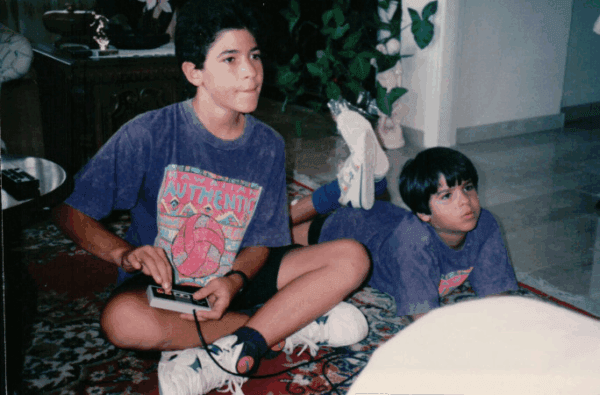
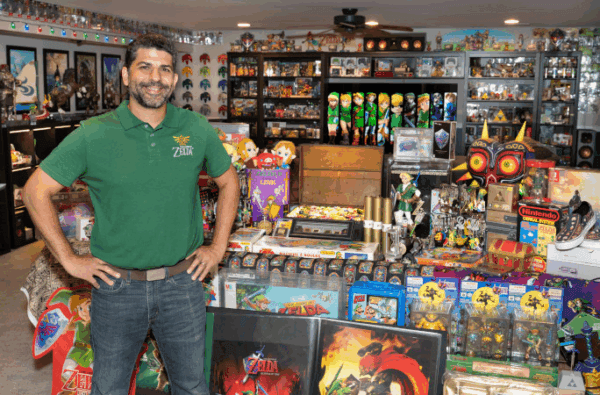
It all began in a quiet household in Fairfax City, Virginia. A young Constantine “Coz” Adams would hear the familiar melodies of The Legend of Zelda before even opening his eyes. His older brother, four and a half years his senior, would spend hours immersed in adventure as Coz watched, glued to the screen. That childhood ritual sparked something profound—a lifelong fascination with Hyrule’s heroics and treasures.
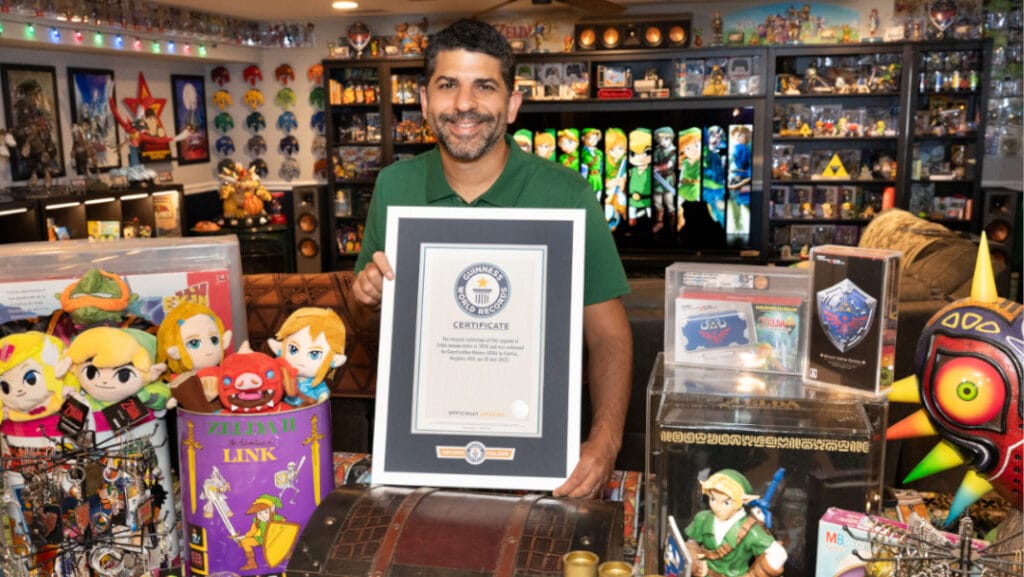
On July 19, 2025, that fascination reached an extraordinary milestone. After twenty-five years of collecting, cataloging, and cherishing, Coz secured the Guinness World Record for the largest collection of The Legend of Zelda memorabilia, tallying an astounding 3,918 pieces in his basement, a figure more than double the previous record held by Anne Martha Harnes of Norway.
Coz describes the record not as a triumphant celebration but as the moment to quietly reveal his achievement. “It was just a goal,” he shared. “Something challenging to do. Now’s my time to show it off.”
A Collection Forged by Passion and Persistence
The journey began in earnest during Coz’s teenage years. At age sixteen, he began collecting games from the NES through PlayStation 2. He sold many of these early acquisitions on eBay, using the proceeds to fund his Zelda hunt. A pivotal turning point came in 2012 when a failed attempt to buy a large lot of Zelda amiibo on Craigslist fueled a determination to track down every Zelda-themed piece.
He says that for years he scanned auction sites and collector networks daily. When he spotted something rare, he knew to act quickly. The thrill was in both the hunt and the acquisition. By 2019, his focus narrowed to Zelda memorabilia alone, and within two years he applied to Guinness World Records, submitting documentation of the 3,918 items and hearing back within weeks, rather than the months he expected.
A Basement Shrine to Hyrule
Coz’s basement now stands as a vibrant tribute to the Zelda universe. Every surface tells a story, from amiibo and game cartridges to apparel, plush figures, promotional hourglasses, and limited-edition collectibles. Among the most treasured items are a sealed Exin Castillos building block set for Ocarina of Time, a vintage lucite sign displaying Link’s face, and promotional hourglasses tied to Phantom Hourglass. Rarest of all are three contest-only scrolls released exclusively in Australia, with fewer than thirty of each known to exist.
Despite the countless official items in his collection, Coz’s personal favorite isn’t something you can buy. He built an entire claw machine themed after Link’s Awakening, the very first Zelda game he played solo. It took a full year to complete. A Raspberry Pi inside plays music from both the 1993 original and the 2019 remake, controlled by a genuine Nintendo controller—an artful tribute to the game that lit the spark for everything that followed
Family, Community, and the Heart of the Quest
Coz’s story always circles back to family. He learned to love Zelda by watching his brother. Now his children Lucas and Elaina have front-row seats to the adventure. His wife Amanda supports his dedication, laughing about their basement being filled with Zelda treasures but proud of his passion. His parents admire the layout and organization, calling the space “a museum dedicated to Zelda”. His brother Eric finds joy in hunting for rare items to surprise Coz with, amazed at the collection’s growth.
It wasn’t until his son flipped through a Guinness World Records book that Coz realized he too could be part of that world. His application followed, and now the record stands—a tangible recognition of years spent following a dream.
Though he’s nearly out of space, Coz isn’t done. For him, collecting remains more than a hobby—it’s about nostalgia, family, creativity, and the stories each piece represents. What started with a Game Boy and Link’s Awakening has become a legend of its own, and Coz’s grand adventure isn’t over—it’s simply reaching new levels.
Fairies in The Legend of Zelda have always been more than just magical creatures — they’re lifelines, guides, guardians, and, at times, eccentric mysteries. Across the franchise, they’ve appeared in many forms: ethereal spirits stored in glass bottles, divine beings blessing Link with sacred powers, and even fully-fledged companions with personalities and backstories. These beings are woven so deeply into Zelda’s identity that it’s difficult to imagine a world of Hyrule without them.
Companions of Courage: The Fairy Guides
Fairy companions in Zelda often act as a bridge between player and game world. The most iconic, Navi from Ocarina of Time, set the template: floating just over Link’s shoulder, offering tips, lore, and combat help. While her persistent voice and the now-infamous “Hey! Listen!” became meme-worthy, she was Nintendo’s answer to making a 3D Hyrule feel approachable.
Later iterations of fairy companions, like Tatl in Majora’s Mask, shifted the tone. Tatl’s sassier personality and brotherly connection to Tael added an emotional depth missing from Navi. In fact, Majora’s Mask places fairies front and center in its story — Tatl is essential to the narrative arc, and the mysterious Stray Fairies play a pivotal role in dungeon rewards, eventually helping you unlock the awe-inspiring Great Fairy Sword.
One of the most underappreciated companions is Ciela, from Phantom Hourglass. Unlike Navi and Tatl, Ciela is more than just a helper — she is eventually revealed to be the Spirit of Courage, tying directly into Hyrule’s divine lore. Her role as both guide and sacred force reflects the evolving complexity of fairy characters during the DS era.
Zelda Central Fact: The Nintendo DS stylus became part of Ciela’s design, turning her into the literal pointer for the player’s touch-based navigation — making her arguably the most interactive fairy in Zelda history.
The Great Fairies: From Sprites to Spirits
Great Fairies have transformed dramatically from game to game. In the 8-bit original, they were humble healers; in A Link to the Past, they became upgrade vendors hidden within Hyrule’s secret corners. But it was the N64 era where Great Fairies became memorable — and divisive.
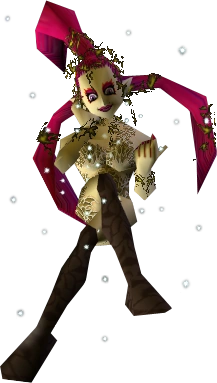
In Ocarina of Time and Majora’s Mask, these characters were visually overwhelming: towering, laughing, shrieking beings with exaggerated designs, glittering hair, and bold stage presence. Despite the discomfort they caused some players, they represented a major design leap — magical women tied to the Triforce themes of Power, Wisdom, and Courage.
By the time The Wind Waker launched, Nintendo radically reimagined their look. The Great Fairies here resemble serene deities, some with multiple arms, vibrant colors, and calm expressions. Their aesthetic draws on Hindu and Buddhist visual motifs — a striking contrast to the flamboyance of their predecessors. Notably, Wind Waker introduced the Fairy Queen, depicted as a childlike divine being with immense magical strength.
Zelda Central Insight: The Queen of Fairies is the only character in The Wind Waker to explicitly mention her royal status over other fairies, making her arguably the most powerful fairy across the sea-faring Zelda titles.
In Breath of the Wild, the Great Fairies got bigger — literally. The four sisters (Cotera, Mija, Kaysa, and Tera) reside in massive blossom-like fountains, and each grows increasingly extravagant in appearance and personality as Link offers more rupees. A fifth entity, Malanya, is known as the Horse God and resides in a similar fountain. While the game doesn’t call Malanya a fairy outright, official guides refer to him as the Horse Fairy, suggesting a rare male counterpart to the Great Fairies.
Bottled Fairies: Zelda’s Magical Lifesavers
Fairies aren’t just characters — they’re some of Zelda’s most iconic items. First appearing in The Legend of Zelda (1986), wild fairies have been collectible companions that automatically revive Link when he falls in battle. Capturing one in a bottle has long been a strategy for survival — and a testament to the series’ magical realism.
Yet, this mechanic raises questions. Are the fairies willing participants? Do they feel pain? The Wind Waker subtly addressed this with distressed facial animations in bottled fairies, while Breath of the Wild sidesteps the issue by using “fairy essence” for cooking recipes — a gentler interpretation.
In a fun reversal, Hyrule Warriors even allows the Great Fairy to wield Link in battle — literally carrying him in a bottle, flipping the dynamic and highlighting the quirky humor Zelda fans love.
Collectible Magic: Stray Fairies & Dungeon Lore
Fairies also serve as dungeon-based collectibles. In Majora’s Mask, each major temple contains 15 Stray Fairies, whose return to a Great Fairy fountain results in major upgrades — such as enhanced magic, defense, or weapons. Unlike typical items, these fairies speak, glow, and emote, making them feel alive even in their fragmentary state.
In Twilight Princess HD, Nintendo added a new collectible mechanic via the Fairy Tears side quest. Once players help the Great Fairy at the Cave of Ordeals, they’re rewarded with Great Fairy’s Tears — the most potent healing potion in the game.
Tingle: Hyrule’s “Fairy” Enthusiast
We can’t talk about fairies in Zelda without acknowledging the green-clad enigma: Tingle. Introduced in Majora’s Mask, Tingle claims to be a reincarnated forest fairy, despite being a grown man with a balloon and a map obsession. His bizarre charm led to multiple appearances — including The Wind Waker, where he runs a chart decoding business (and possibly a criminal operation from his private island).
Zelda Central Trivia: Tingle is one of the few Zelda characters to get his own spinoff series, including Freshly-Picked Tingle’s Rosy Rupeeland and Ripened Tingle’s Balloon Trip of Love — though most of them never left Japan.
The Future of Fairies in Zelda
With Tears of the Kingdom expanding on Breath of the Wild’s foundation, fans are wondering: what’s next for fairies in Zelda? Will we see a return to companion-style fairies like Navi or Ciela? Will new fountains be discovered across Hyrule and the skies above? Could we even see a game where Link is a fairy?
Determining the best Zelda DS game is an easier feat than it may seem. The Nintendo DS and 3DS gave Zelda fans a surprising range of adventures—six official titles spanning ports, remakes, sequels, and one brand-new timeline entry. Across these two systems, the lineup included:
Phantom Hourglass (2007) – DS exclusive
Spirit Tracks (2009) – DS exclusive
Ocarina of Time 3D (2011) – 3DS remake
A Link Between Worlds (2013) – 3DS exclusive sequel to A Link to the Past
Majora’s Mask 3D (2015) – 3DS remake
Tri Force Heroes (2015) – 3DS multiplayer-focused spin-off
Among these six games, only two were built entirely from the ground up for the Nintendo DS: Phantom Hourglass and Spirit Tracks. While the 3DS offered refinements of N64-era masterpieces and a few bold new experiments, the DS was where Nintendo truly leaned into hardware-specific innovation. These two titles weren’t just entries in the Zelda timeline—they were testbeds for stylus-based controls, microphone puzzles, and new ways to experience Hyrule on a portable screen.
And though the 3DS titles often steal the spotlight in retrospective rankings—thanks to the legacy of Ocarina or the inventive brilliance of A Link Between Worlds—it’s Phantom Hourglass and Spirit Tracks that embody the spirit of experimentation that defined Zelda’s DS era.
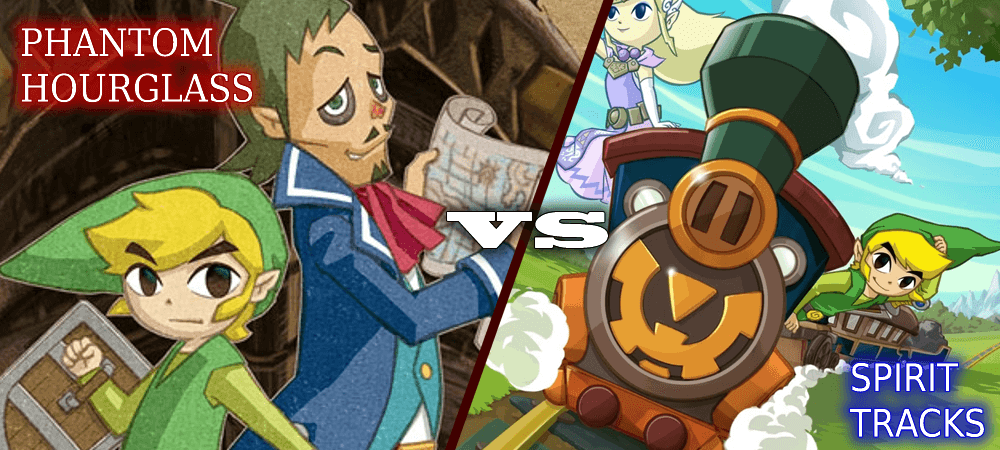
This article doesn’t aim to pit all six handheld Zelda games against one another. Instead, we’re zooming in on the platform-exclusive DS entries in making the determination of the best Zelda DS release, the only ones that can truly be considered native to the dual-screen system. The question is simple: Between Phantom Hourglass and Spirit Tracks, which is the best DS Zelda?
Let’s set sail—and maybe lay some tracks—on the road to that answer.
Best Zelda DS Contender #1: Phantom Hourglass – A Nautical Adventure
Right out of the gate, Phantom Hourglass did what few Zelda games had dared—it asked you to forget buttons. Movement, swordplay, map annotations, and item usage were all handled via the stylus. The gamble paid off.
It was a direct continuation of The Wind Waker, giving us more Tetra, more Toon Link, and more seafaring exploration—albeit scaled down for handheld play. It wasn’t just nostalgia bait, either: the Ocean King’s Temple introduced a pseudo-roguelike progression system long before the genre surged in popularity. The Phantom guards were menacing, the time mechanic added pressure, and the sense of returning stronger with new tools nailed that core Zelda loop.
Fans praised its clever dungeon design, satisfying puzzles, and the way it turned the DS hardware into a game mechanic. Scribbling notes on maps felt essential, not gimmicky. And how could we forget the treasure maps, salvage crane mini-games, and customizable ship parts?
Commercially, Phantom Hourglass was a success, selling approximately 4.76 million copies worldwide. Its critical acclaim and strong sales underscore its impact on the Zelda franchise and handheld gaming. Could this title be the best Zelda DS game?
Hardcore takeaway: Phantom Hourglass succeeded because it respected the puzzle-first philosophy of classic Zelda while rethinking how to interact with the world.
Best Zelda DS Contender #2:Spirit Tracks – On the Rails
Two years later, Spirit Tracksbarreled onto the scene—literally. Ditching open seas for a train on fixed rails, this game introduced Hyrule’s first major transportation grid. It expanded on its predecessor in several ways: the dungeons were meatier, Zelda herself was finally a true companion, and controlling Phantoms in tandem with Link opened the door for some of the series’ most interesting dual-character puzzles.
But here’s where it divides the fanbase:
The overworld was no longer open—it was a railroad, both literally and figuratively. Exploration was reduced to station-hopping. Need to backtrack? You’re doing it in real time at 20 mph. Some players felt the Spirit Flute’s reliance on microphone input took novelty too far—great when it worked, annoying when it didn’t.
Still, Spirit Tracks dared to push the Zelda formula. It just asked you to accept a few clunky concessions along the way.
In terms of sales, Spirit Tracks sold approximately 2.96 million copies worldwide. While respectable, it fell short of its predecessor’s commercial performance. Could the best Zelda DS title have such low sales volume?
Hardcore takeaway: It was bold, but it occasionally let its big ideas get in the way of fluid gameplay.
The gaming community has often debated the merits of these two titles. In various forums and discussions, players have highlighted Phantom Hourglass for its better pacing, more engaging exploration, and superior use of the DS’s features. Conversely, while Spirit Tracks was acknowledged for its improved dungeon design, the overall consensus leaned towards Phantom Hourglass as the more enjoyable experience.
Honorable Mention: Four Swords Adventures (DSiWare version)
While not a traditional DS game, we’d be remiss not to shout out Four Swords Anniversary Edition (available briefly via DSiWare). If you managed to grab it before it vanished, you know how much chaotic fun local co-op Zelda can be.
Conclusion
Both Phantom Hourglass and Spirit Tracks brought fresh ideas to the Zelda series on the DS, each with its own strengths and innovations. However, considering the intuitive controls, engaging exploration, and overall reception, Phantom Hourglass stands out as the best Zelda game on the Nintendo DS. Its successful integration of the DS’s unique features and its continuation of the beloved Wind Waker storyline make it a must-play for fans of the series.
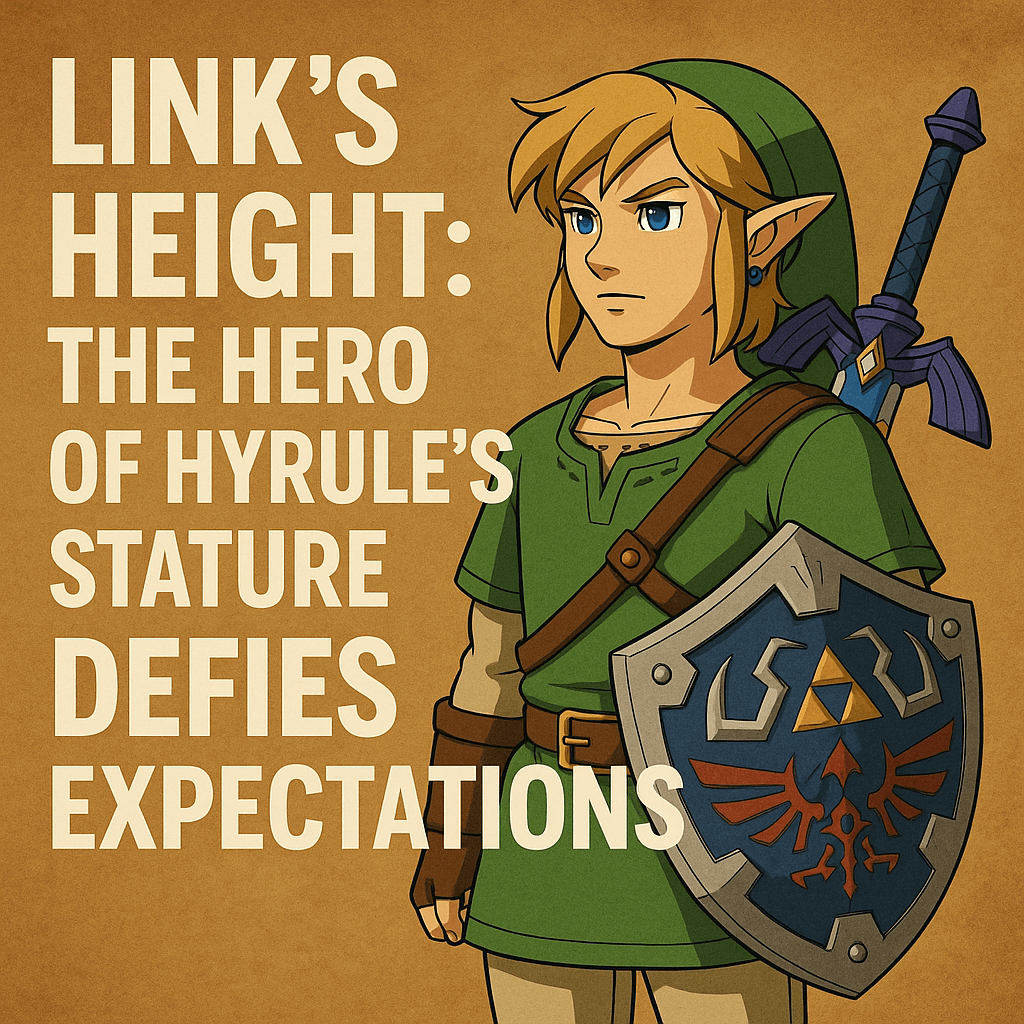
Link’s Height: The Hero of Hyrule’s Stature Defies Expectations
In the vast realm of video game protagonists, physical stature often correlates with perceived strength and heroism. Towering figures like Kratos and Master Chief dominate their narratives not just through their actions but also through their imposing presence. However, Link’s height in The Legend of Zelda series presents a compelling deviation from this norm.
Deciphering Link’s Height Across the Series
Nintendo has never officially disclosed Link’s exact height, leading fans to embark on their own investigative journeys. In Breath of the Wild, YouTuber The Bread Pirate conducted an in-depth analysis using in-game objects, estimating Link’s height at approximately 5’2″ (158.5 cm) . Contrastingly, a Tumblr user named crunchyfield revisited this measurement, accounting for potential parallax errors, and proposed that Link might stand closer to 5’8″ (173 cm).
Further back in the series, Ocarina of Time offers a unique opportunity to gauge Link’s height. In the Lakeside Laboratory, a measuring stick suggests that adult Link stands around 5’7″ (170 cm) . Similarly, analyses of character models from Twilight Princess estimate Link’s height at 165 cm (approximately 5’5″), with Princess Zelda standing taller at 173 cm (approximately 5’8″).
A Hero’s Stature in a World of Giants
Regardless of the exact figure, it’s evident that Link often appears shorter than many of his counterparts in Hyrule. In Breath of the Wild and Tears of the Kingdom, he frequently looks up to converse with characters like the Gerudo, who are canonically around 8 feet tall . Yet, this height disparity is never portrayed as a disadvantage. Link’s prowess with the Master Sword, his agility, and his unwavering courage consistently position him as Hyrule’s foremost champion.
Challenging Stereotypes: Link Among Other Short Heroes
Link’s stature places him among a select group of protagonists who defy traditional height expectations. Characters like Kenshin Himura from Rurouni Kenshin, standing at 5’2″, and Wolverine from the X-Men, at 5’3″, share this trait. However, while these characters often confront challenges or stereotypes related to their height, Link’s adventures rarely, if ever, highlight his stature as a focal point. His heroism is intrinsic, not defined by overcoming perceptions tied to his physical appearance.
Embracing a New Archetype of Heroism
In an industry where towering figures often symbolize strength, Link’s height offers a refreshing perspective. His consistent portrayal as a formidable hero, irrespective of his stature, challenges conventional narratives and broadens the scope of representation in gaming. For fans and players alike, Link embodies the principle that true heroism stems from character, determination, and heart—not just height.