




















Facebook Instagram Discord

Choose Your Adventure

Legend of Zelda News

Latest Articles

New Research Shows How Breath of the Wild Improves Happiness and Well-Being

Breath of the Wild Study Reveals Why Exploring Hyrule Makes Us Happier

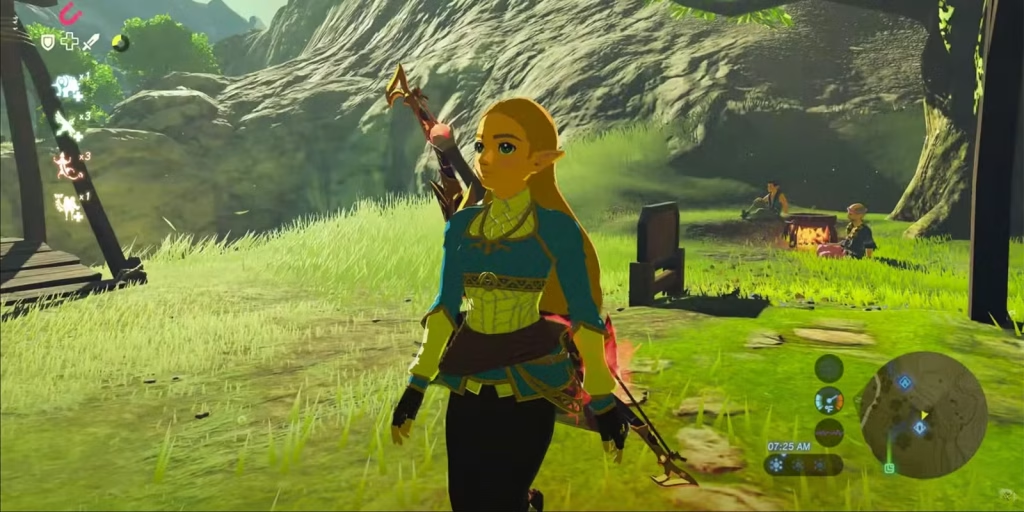
The Legend of Zelda: Breath of the Wild isn’t just a game. It is an experience that invites you to wander, to breathe deeply, and to feel something profound. A recent exploratory lab study published in JMIR Serious Games explores exactly how this open-world masterpiece, when paired with the lingering warmth of nostalgia inspired by Studio Ghibli classics, can enrich one’s sense of purpose, calm, and joy in life.

Escaping Stress Through Hyrule

Imagine you’re a postgraduate student, stressed by deadlines and weighed down by anxious thoughts. Now picture slipping into the vast landscapes of Hyrule, where every gentle breeze through the tall grass or mountain vista whispers of freedom. In the study, more than 500 participants were randomly assigned to play Breath of the Wild or not, with some also watching nostalgic clips from Ghibli hits like My Neighbor Totoro or Kiki’s Delivery Service. Afterward they answered questions about exploration, calm, mastery, meaning, and overall happiness.

The Power of Play and Nostalgia

The results were striking. Those who played the game reported a significantly higher sense of happiness in life, averaging 4.56 compared with 3.17 for those who did not play. Nostalgia added another layer. Players who also watched Ghibli’s comforting scenes scored even higher, reaching an average happiness score of 5.45 compared with 3.58 for those without that emotional cue.

Exploring, Mastery, and Calm

What is especially fascinating is how these feelings translated into overall wellbeing. The sense of exploration that Breath of the Wild so beautifully evokes contributed directly. That easing of tension as you glide across a grassy field or explore a hidden cave made a real difference. A growing sense of mastery through puzzles and combat, and a stronger feeling of meaning in the adventure, all played their part in boosting happiness.

Why This Matters for Zelda Fans

So why does this matter for Zelda fans? It is not only about enjoying the story or appreciating the gameplay, though those remain important. This research suggests that Breath of the Wild, especially when supported by the right emotional context, can nurture emotional states that genuinely increase our happiness. Nostalgic memories of Ghibli films may prime us to be more receptive to the beauty these worlds offer.

A Reminder of Why Zelda Resonates

Picture pairing a Zelda session with the gentle memory of Totoro wandering in a sunlit forest or Kiki watching over a quiet town at dusk. The combination taps into something deep and meaningful, creating a moment of calm mastery and heartfelt joy. These stories resonate because they speak to our sense of wonder and purpose, reminding us of the quiet beauty of being present.

In the end, Breath of the Wild is not only a game to complete. It is a world in which we can rediscover curiosity, calm, and growth. When joined with the gentle nostalgia of Ghibli’s timeless charm, it becomes more than play. It becomes a reminder of what it means to feel alive and content.

LittleJem Sails the Great Sea in Real Life: A Fan Build That Makes Wind Waker Tangible

Every so often a fan project comes along that blurs the line between fantasy and reality. This time, prop maker and costume designer LittleJem has brought one of the most iconic companions from The Legend of Zelda: The Wind Waker into our world. She built a life-size version of the King of the Red Lions and, in true Wind Waker spirit, launched it on the open water.

The video above captures the full journey: from the design and building process to the breathtaking moment when the King of the Red Lions actually sails. It’s not just a replica—it’s a working tribute to the vessel that guided Link across the Great Sea.

Craftsmanship That Honors the Game

From the bold red hull to the expressive dragon figurehead, LittleJem’s attention to detail is remarkable. Coverage from retro gaming outlets praised how the real-world build mirrors the cel-shaded aesthetic of the original, noting the clean paintwork, vibrant sail crest, and expressive facial features that give the boat its personality.

The balance between faithful design and seaworthy structure is what sells the illusion. Wind Waker’s art style is simple and stylized, but bringing it into reality required careful choices—sharp lines, crisp colors, and textures that look right under natural sunlight. The result feels like the King of the Red Lions has leapt straight from the GameCube into the real world.

From Dream to Maiden Voyage

What makes this project truly special is that it isn’t confined to land. The video documents the Red Lions’ maiden voyage, proving that the craft doesn’t just look the part—it moves with grace on the water. Watching it glide across the waves transforms nostalgia into a living moment, echoing the game’s theme of exploration and freedom.

A Shared Journey with Fans

From the beginning, Jem framed this as a community project. On her YouTube channel and social feeds, she shared behind-the-scenes progress, from hull construction to sail rigging, allowing fans to follow each step. That transparency makes the final reveal even more satisfying, as you’ve seen the hours of craftsmanship build toward that first sail.

Fan reactions across forums and comment threads have been enthusiastic. Many call it one of the most ambitious Zelda tributes ever attempted, while others dream aloud of cosplaying Link and Tetra alongside the boat at future events. The Red Lions has always been more than transport—it’s a companion with personality—and fans immediately recognize that in Jem’s build.

Why It Resonates with Zelda Fans

Wind Waker’s Great Sea is more than just a map; it’s a symbol of choice, freedom, and trust in the wind. The King of the Red Lions embodies that spirit as both vessel and mentor. Seeing a fan recreate it as a functioning boat captures everything that made the game unforgettable. It’s a reminder of the creativity the Zelda community continues to inspire, two decades after the game first launched.

Follow the Adventure

If the video has you captivated, be sure to follow LittleJem’s channel for more. She continues to document the process and tease potential future projects, keeping the adventure alive. For Zelda fans, it’s both a love letter to Wind Waker and a challenge—what piece of Hyrule will you bring to life next?

How a Solo Creator Reimagined Majora’s Mask in Unreal Engine 5

It started as a one‐man ambition: to walk through the streets of Clocktown and the rolling plain of Termina Field, but not in Nintendo 64 blockiness—fully built in Unreal Engine 5. French 3D-artist Benoit Bourgerie dedicated just over twelve months to this fan homage, and the result is a video that feels like stepping inside Majora’s Mask itself, yet completely modern.

Watching it, you’ll recognize all the landmarks—especially the clocktower staking its claim over the plaza—but they’re rendered with an eloquent polish. Bourgerie bypassed copying textures and instead sculpted Clocktown and Termina Field from scratch, using UE5’s Nanite system so the model count stays sky-high with no frame problems, and Lumen gives the streets and fields real-time shadow shifts as if Link just stepped into the light. The terrain owes its subtle dips and ridges to William Faucher’s Easy Mapper plugin, and the coding-free approach freed Bourgerie to focus on atmosphere.

Even more striking, his art direction stays faithful to Majora’s original tearful beauty rather than chasing photo-realism. As DSOGaming observed, “this fan remake has managed to retain the cartoon-ish style of the game,” and “so, this should please a lot of Zelda fans.” The hues feel softer, the silhouettes familiar. But when the Moon looms, when the shadows stretch, you feel Majora’s dread again—enhanced, but not changed.

Where some fan projects go for effects over feeling, this one treads lightly. A remix of the Song of Healing by Qumu plays over scenes of the fountain plaza and field grasses, reminding you that this was born from nostalgia, not ambition. It’s as though Bourgerie composed the visuals to the music, tying the melancholic mood of Termina to voices inside the camera.

This isn’t a mod, it’s not a playable world, and there’s no download. In fact, it was created entirely for Bourgerie’s portfolio, a passion piece made for experience, not distribution. Yet because of that, it exists as a pure recreation—no licensing, no mission objectives, just atmosphere.

Zelda fans should watch it not because it offers gameplay but because it sparks imagination. It takes a small, character-driven world and honors what made it special: three days of recurring dread, every NPC with a schedule, every corner soaked in clock-tower shadow. Bourgerie captured the intimacy of that world and lifted it to modern shine without losing the spirit. In many ways it shows what Nintendo itself might achieve if Majora ’s Mask ever returns via Unreal Engine.

Zelda Central invites you to watch the full tour on YouTube and explore for yourself: do you drift toward the Milk Bar at dawn or peer across the field toward the swamp at midnight? Let us know in the forum—it’s the soundtrack and scenery that still makes this world unforgettable.

Hyrule Warriors: Age of Imprisonment’s Brazilian Rating Fuels Summer Direct Speculation

Koei Tecmo’s Hyrule Warriors spin-off, Age of Imprisonment, has officially received an age rating in Brazil — and Zelda fans everywhere are buzzing that it could mean a new Nintendo Direct is just around the corner.

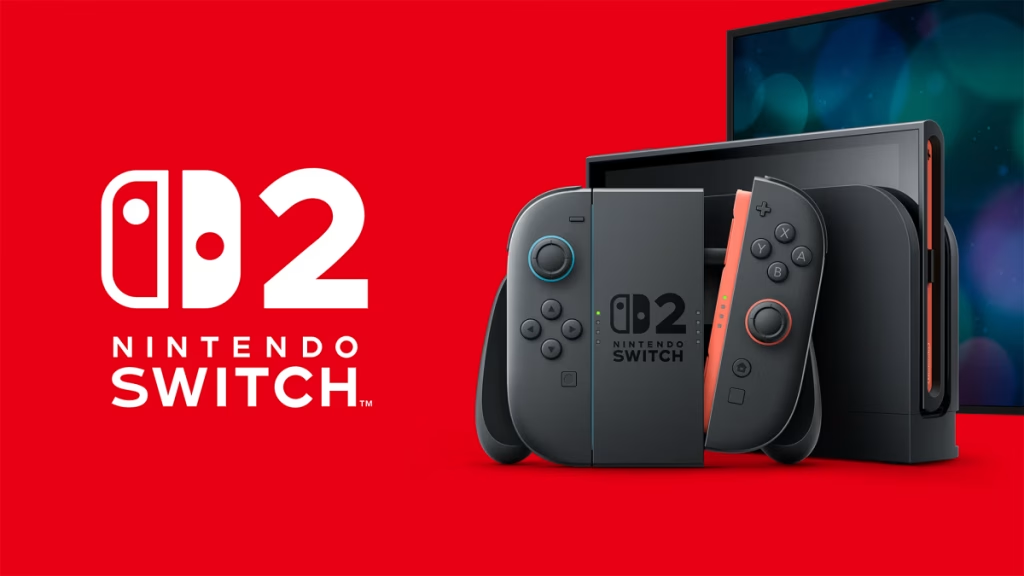
The Brazilian board has classified the title as suitable for ages 12‒plus, despite Nintendo reportedly requesting a 10+ rating. While ratings don’t guarantee imminent release, they typically mark a game that’s nearing its final, polished form. This comes after Nintendo already pegged Age of Imprisonment for release “this winter” on the Nintendo Switch 2 — though an exact release date has yet to be announced.

With Donkey Kong Bananza now out and July’s Pokémon Presents wrapped up, fans are eyeing the end of July as the most likely window for a surprise Nintendo Direct — and what better opportunity to reveal a release date for Age of Imprisonment and unveil more upcoming Switch 2 titles

Why This Matters for Zelda Fans

  • Rating reveals often coincide with governments reviewing a nearly completed version of the game — so it hints that development is reaching its final stages.
  • Nintendo has already confirmed Age of Imprisonment for the Switch 2 and said it’s coming this winter — but determining whether winter means December 2025 or January 2026 is still up in the air.
  • A Direct this July would be the perfect moment to drop a release date and showcase more Switch 2 Zelda projects, like the rumored Animal Crossing sequel and other new titles.

What to Watch For on Zelda Central

  • Release Date Drop: Will Nintendo confirm whether “this winter” means 2025 or early 2026?
  • New Gameplay Trailer: Expect more footage featuring Princess Zelda, King Rauru, and massive Musou-style battles.
  • Possible Bonus Announcements: Watch for news on upgrades to Age of Calamity, a possible trilogy collection, or other upcoming Zelda spin-offs.

As Hyrule Warriors: Age of Imprisonment inches closer to launch, all eyes are on Nintendo — a summer reveal could be just days away. Let us know your predictions — release dates? new characters? full trilogy? We want to hear what Zelda fans are hoping to see.

Google Hides Zelda Easter Eggs for Live-Action Link and Zelda Cast Searches

As excitement builds for the upcoming Legend of Zelda live-action movie, Google has quietly joined the celebration—with a few cleverly hidden tributes to Hyrule’s newest heroes.

Following last week’s official casting announcement from Nintendo, fans flocked to Google to learn more about Bo Bragason and Benjamin Evan Ainsworth, the fresh-faced stars set to portray Princess Zelda and Link. Unlike the star-studded cast of The Super Mario Bros. Movie, Bragason and Ainsworth are rising talents—meaning even diehard Zelda fans may not have recognized them at first.

But try typing either actor’s name into Google now, and you’ll be treated to a little something extra.

Search for Bo Bragason, and the phrase “Excuse me, Princess” bounces playfully at the top of the screen—complete with a cheeky female elf emoji. It’s a clear nod to the cult-favorite animated Zelda series from the late ‘80s, where that sarcastic catchphrase became Link’s most infamous line.

Look up Benjamin Evan Ainsworth, and you’ll be greeted with a triumphant “KYAAA! HYAAAAA!” plus a male elf emoji—an unmistakable reference to Link’s signature battle cries from nearly every Zelda title, from Ocarina of Time to Tears of the Kingdom.

These fun little flourishes aren’t Google’s first foray into pop culture Easter eggs. Earlier this month, the search giant tipped its hat to Oasis fans by tweaking search suggestions for phrases like “Oasis tour” to return “Did you mean: Madferit?” And Lewis Capaldi fans might recall the “Welcome back Lewis – Someone we love” message that briefly appeared in his honor.

But for Zelda fans, this might be the most exciting one yet.

While Nintendo has yet to share any major plot details or even the setting of the live-action film, director Wes Ball has confirmed he wants the movie to feel “grounded” and “real,” with minimal motion capture and a strong cinematic atmosphere. As of now, the film is still aiming for a theatrical release within the next two years.

Until then, it’s a great time to dive into the past work of Bragason and Ainsworth—especially now that Google has added a bit of Hyrule flair to the search experience.

Want to know where else you might’ve seen the new Link and Zelda? Check out our [actor spotlight feature] on both stars, only on Zelda Central.

Legend of Zelda Live‑Action: Bo Bragason & Benjamin Ainsworth Cast as Zelda & Link!

Nintendo and Sony have officially cast the leads in their live-action adaptation of The Legend of Zelda. In a Wednesday post, legendary game designer Shigeru Miyamoto revealed that Bo Bragason will portray Princess Zelda and Benjamin Evan Ainsworth will step into the role of Link. The announcement came complete with the first official costume photos of the pair.

Bragason, a British actress, has appeared in BBC One’s Three Girls and The Jetty, as well as Disney+’s Renegade Nell and the 2024 vampire comedy The Radleys. Ainsworth, also from the U.K., brings experience from The Haunting of Bly Manor, Netflix’s The Sandman, Disney’s live-action Pinocchio, and the Canadian comedy Son of a Critch.

Set to hit theaters on May 7, 2027, the film was pushed back from its original March release due to production adjustments. Directed by Wes Ball—best known for The Maze Runner series and Kingdom of the Planet of the Apes—the movie promises a fresh take on Hyrule, embracing a tone more aligned with Hayao Miyazaki’s whimsical fantasy than the epic sweep of Lord of the Rings. Miyamoto and Avi Arad are producing, with Sony Pictures co-financing alongside Nintendo.

This casting ends weeks of speculation—Euphoria star Hunter Schafer was among the fan favorites for Zelda, but the role ultimately went to the relative newcomer, Bragason.

Nintendo and Sony appear to be setting up a long-term vision by choosing rising young actors—Ainsworth is just 16—mirroring strategies behind franchises like Harry Potter and Stranger Things.

With the success of The Super Mario Bros. Movie fresh in mind, expectations are high. Can Zelda capture similar magic? Fans and critics alike will be watching closely when she steps onto the big screen in 2027.

Echoes & Bind: Nintendo Files Patents for Key Mechanics in Echoes of Wisdom

Echoes of Wisdom Official Art

Two of the most talked-about mechanics in The Legend of Zelda: Echoes of Wisdom; the Echoes system and the Bind mechanic have officially been patented by Nintendo.

Echoes Patent

One patent covers the “Echoes” feature, where players use the Tri Rod to summon “echoes” (replicas of objects or creatures) for combat, traversal, and puzzle-solving. The patent abstract states it “automatically control[s] a plurality of kinds of dynamic objects … and interact[s] with imitation objects …” The diagrams clearly depict the Echoes system players know and love.

Bind Patent

The second patent details the “Bind” mechanic. It describes a two-state interaction:

  1. A dynamic object is moved alongside the player;
  2. The player is moved along with the object (reverse bind);

It even states these states can be switched “based on an operation input”—a perfect match for the in-game bind/reverse bind moves.

Patent Publication

Both applications were published by the United States Patent and Trademark Office on June 26, 2025.

Echoes of Wisdom patents have been published, just in time for its Switch 2 glow up.“Echo” patent (78 pages!)image-ppubs.uspto.gov/dirsearch-pu…“Bind” patentimage-ppubs.uspto.gov/dirsearch-pu…

Nintendo Patents Watch (@ninpatentswatch.bsky.social) 2025-06-26T11:52:50.373Z

Nintendo’s Patent Strategy

These filings continue Nintendo’s trend of patenting mechanics from Tears of the Kingdom (like Ultrahand and Ascend). As long as Nintendo keeps innovating in the Zelda series, expect more mechanics to be patented.

What This Means

Patenting gameplay mechanics is rare in game design, and it sparked reactions within the community. Some argue that ideas like moving platforms with a player atop have existed for decades—and that broad patents like these could stifle innovation.

At the same time, Nintendo’s patenting shows they view these systems as valuable intellectual property—ones they could protect or license in the future.

Your Thoughts?
What do you make of Nintendo’s move to patent Echoes and Bind? Smart protectiveness or overly broad claim? Let us know in the comments!

Nintendo Music Adds Ocarina of Time 3D OST — Every Track Listed!

Nintendo Music Adds Ocarina of Time 3D OST — Every Track Listed!

Nintendo Music continues to grow its library, and today’s update brings the beloved The Legend of Zelda: Ocarina of Time 3D soundtrack to the service. This version is a faithful port from the 3DS remake, originally released in June 2011, and includes all 51 tracks—totaling just over 1 hour and 14 minutes of music.

The full Ocarina of Time 3D set joins the original N64 OST and several other Zelda soundtracks already available on Nintendo Music.

Tracklist (51 Tracks)

Journey & Adventure Themes

  • Title Theme
  • Deku Tree
  • Fairy Flying
  • House
  • Kokiri Forest
  • Shop
  • Battle
  • Inside the Deku Tree
  • Boss Battle
  • Hyrule Field Main Theme
  • Kaepora Gaebora’s Theme
  • Market
  • Hyrule Castle
  • Zelda’s Theme
  • Lon Lon Ranch
  • Kakariko Village
  • Windmill Hut
  • Goron City
  • Lost Woods
  • Middle Boss Battle
  • Dinosaur Boss Battle
  • Great Fairy’s Fountain
  • Zora’s Domain
  • Temple of Time
  • Master Sword
  • Ganondorf’s Theme
  • Chamber of the Sages
  • Sheik’s Theme
  • Horse Race
  • Kakariko Village “Orchestral Version”

Ocarina Songs & Dungeons

  • Ocarina Songs
  • Potion Shop
  • Minuet of Forest
  • Forest Temple
  • Prelude of Light
  • Bolero of Fire
  • Fire Temple
  • Ice Cavern
  • Serenade of Water
  • Water Temple
  • Nocturne of Shadow
  • Shadow Temple
  • Gerudo Valley
  • Requiem of Spirit
  • Spirit Temple
  • Kotake & Koume’s Theme
  • Ganondorf Battle
  • Last Battle
  • Ocarina of Time
  • End Credits
  • End Credits 2

(Yes—spoiler alert: the final track End Credits 2 is a real-instrument orchestral performance exclusive to this release.)


Nintendo Music

Why It Matters for Zelda Fans

  • Rediscover legendary tracks: While the N64 OST is iconic, the 3DS version features subtle re-arrangements and clearer audio, courtesy of Mahito Yokota and Takeshi Hama under Koji Kondo’s direction.
  • Plenty of listening options: Nintendo Music offers easily loopable tracks and curated playlists for HEROIC themes, dungeon ambiance, or soothing Hyrule vibes.
  • Fully accessible: All tracks are included in the update—no missing gems, so dive in for a musical marathon!

How to Listen

You’ll need a valid Nintendo Switch Online subscription. Then simply:

  1. Download or open the Nintendo Music app on iOS or Android.
  2. Search for “Ocarina of Time 3D” or check the 3DS releases section (added July 8, 2025).
  3. Cue your favorite themes—battle it out, solve puzzles, or just relax to Hyrule’s orchestrated landscape.

Why not stream through the Title Theme or loop the End Credits 2 orchestral finale and soak in those nostalgic notes? Whether you’re catching every cue from Kokiri Forest or reliving Shadow Temple chills—this update is a full-on Zelda music celebration ?

Let us know: which track takes you back to your first Hyrule adventure?

Final Fantasy XIV’s Naoki Yoshida Applauds Zelda: Echoes of Wisdom’s Brilliant Design

Final Fantasy XIV director and producer Naoki Yoshida has high praise for The Legend of Zelda: Echoes of Wisdom, calling it one of the most impressive games he’s played recently—and not just as a fan, but as a fellow game developer.

In a new interview with Famitsu, Yoshida shared how deeply he admired Echoes of Wisdom, highlighting its smart use of resources, thoughtful design, and development philosophy. According to him, it’s a standout example of how to create a fun game without ballooning production costs.

“All recent games are interesting,” Yoshida said, “but I was particularly impressed with The Legend of Zelda: Echoes of Wisdom.” He emphasized how Grezzo—the studio behind this original Zelda spin-off—delivered an experience that felt fresh and fun while cleverly reusing assets from past titles.

“The base resources are almost the same as other Zelda games,” he noted, pointing out how the development team focused entirely on gameplay innovation while being mindful of budget. Instead of chasing massive sales or flashy production, they made fun the priority. And that, to him, was what made it truly remarkable.

Yoshida even described the game as a great case study for aspiring developers. “That work was born because the knowledge of veterans and the sensibilities of young people worked very well together as a team,” he explained. “I hope new developers play it from that perspective. For me, it’s an extremely noteworthy title.”

He also called attention to the game’s balance between creativity and constraint—how the decision to reuse assets wasn’t just practical but strategic. “This idea doesn’t come about overnight,” he said. “It’s a form that could only be created by a team that knows their strengths and works together with a shared vision.”

The Legend of Zelda: Echoes of Wisdom released in September 2024 as the first original Zelda title developed by Grezzo, the studio previously known for handling remakes like Link’s Awakening and Ocarina of Time 3D. The game recently received a quality-of-life update improving its Echoes menu system, further refining the unique gameplay concept it introduced.

Whether you’re a longtime Zelda fan or a game designer looking for inspiration, Yoshida’s words remind us that greatness in game development isn’t always about scale—it’s about thoughtful craftsmanship.

Hyrule’s Skyfall Creatures, Ganondorf & More: In-Depth Exploit Breakdown

The Tears of the Kingdom Switch 2 Edition may appear to be a simple upgrade—higher resolution, smoother framerate—but revealed via the Zelda Notes Autobuild QR share feature is a world of creative chaos. Players are now summoning herds of Epona, swarms of dogs, and even Ganondorf himself.

1. Mod Save Files on a Switch 1

Fans using tools like those from the Hyrule Engineering community edit their Switch 1 save files to swap authorized Autobuild actors (e.g., hover platforms) with banned ones—Ganondorf, Epona, etc.

2. Transfer Saves to Switch 2 Edition

The modified save data travels through a standard process—modded Switch 1 → standard Switch → Switch 2—preserving these altered actors.

3. Upload, Generate & Scan QR

Once uploaded via Zelda Notes, the game generates a QR code. Scanning it on any Switch 2 brings the custom build into the player’s world.

Video Highlight

Summoning Highlights

  • Endless Epona herds – Horse stampedes across Hyrule, all from a single QR.
  • Dog armies – While players still cannot pet them, the code floods the world with un-pettable doggos. Redditor Mz3player said: “The dog one turns the Switch 2 version from trivial to essential.”
  • Ganondorf NPC spawns – Facing multiple copies of the Demon King stalking Link is now possible. One user shared screenshots of an army of Ganondorfs.

Community Reactions

Reddit’s r/tearsofthekingdom thread titled “Totk autobuild sharing is so broken” is buzzing:

“Yes and yes.”
Formal-Code2341, confirming both Epona and Ganon codes are real

Another user, lgxmo, summarized community sentiment:

“Nice, this is the good kind of ‘broken’. Unfortunately, Nintendo will probably patch it.

Media Insight

  • Nintendo Life explains how no validity checks are performed on shared actors—meaning anything can be included.
  • VICE reports that even though Switch 2 is not compromised, using modded Switch 1 data is enough to bypass built-in restrictions.

The Road Ahead: Is a Patch Coming?

The community expects Nintendo to intervene:

“Odd that they don’t have autobuild legitimacy verification… Nintendo could patch it.” (As described by Aster on Reddit.)

  • Some fear consequences: modded setups carry risks like save corruption or online bans.
  • Others embrace the fun—experimenting while the exploit lasts.

Advice for Zelda Central Readers

  • Interested modders: Visit the Hyrule Engineering Discord or relevant Reddit communities for QR codes.
  • Backup before you hack: Modding carries risks—saving before trying anything is essential.
  • Act fast: These exploits won’t remain valid indefinitely; enjoy them while they last.
  • Non-modders: You can still scan QR codes on Switch 2—but note that someone had to mod to create them in the first place.

What started as a sophisticated performance update in Tears of the Kingdom has become a canvas for community ingenuity. Using Zelda Notes and QR codes, Switch 2 players can summon horses, dogs, and Ganondorf through a clever save-file hack—but Nintendo will likely plug this loophole soon. Enjoy the spectacle while it’s available.

Google is changing how it surfaces content. Prioritize our high-quality Zelda guides and expert coverage in search results by setting ZeldaCentral.com as a preferred source.