























Static recompilation translates a game’s code into a form that can run natively on another system. One project, Ocarina Recomp, converts the game’s code to C and translates its Switch 2 graphics for Vulkan. It builds on a player’s own game files; the project does not include the game or a ready-to-run copy.
Early builds reach Kokiri Forest
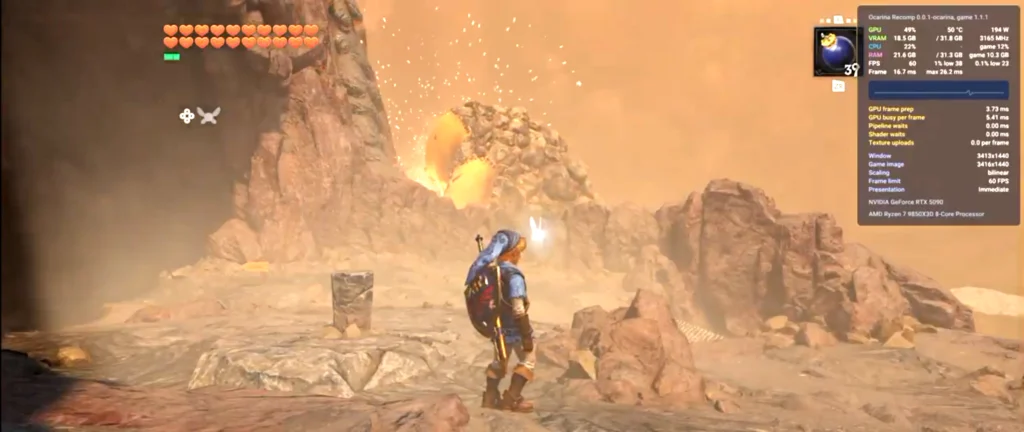
Ocarina Recomp’s developers describe the project as experimental. Its latest status says it has been tested on one PC, with the opening and gameplay through the Great Deku Tree working. Sound, videos, controllers, and save files are also supported, but Hyrule Field and the rest of the game have not been tested. The project reports performance of about 59 frames per second while standing still and 51 to 55 frames per second while walking on a PC with an RTX 5090. Stuttering can occur when entering a new area, and other graphics cards have not been tested by the developers.
A separate project called Hookshot is also attempting a native Windows version using static recompilation. Its developers report that Kokiri Forest is playable, with sound, controls, and saves working, while the rest of the game remains untested. Hookshot also lists options such as ultrawide display support and frame generation, though its project notes warn of limitations and unfinished testing.
Impressive footage, but not a finished PC release
Notebookcheck highlighted footage posted to X showing the remake running in ultrawide on a PC. The article reported that the clip showed 60 frames per second and 18.6 GB of VRAM use on an RTX 5090. That figure describes the particular footage; it should not be taken as a general performance requirement for every recompilation project or build.
The rapid progress is notable, but the projects are still limited experiments. Their reported results come from early testing on specific hardware, and neither project has verified the full adventure from start to finish. For now, Switch 2 remains the straightforward way to play the remake.
